


When an orb flashes in a video, watch the unedited clip and check whether the spot is the only thing that changes. Room lights, automatic exposure, movement and night vision can make something brighten and fade. A note about the timing gives you a better starting point than a slowed-down clip on its own.
Check whether the whole frame pulses
Start at the original playback speed. Then pause and check a few frames before, during and after the flash. Mark the time and whether the orb moves, gets larger or simply changes brightness. Check a white wall or a stationary light in the same clip. If it also changes, the camera may be reacting to lighting across the scene.
LED lights can flicker in ways a camera records as brightness shifts or bands. Sony’s guide to camera flickering explains how timing and shutter settings can affect what appears. On an infrared camera, also check whether a tiny object close to the lens reflects its illumination.
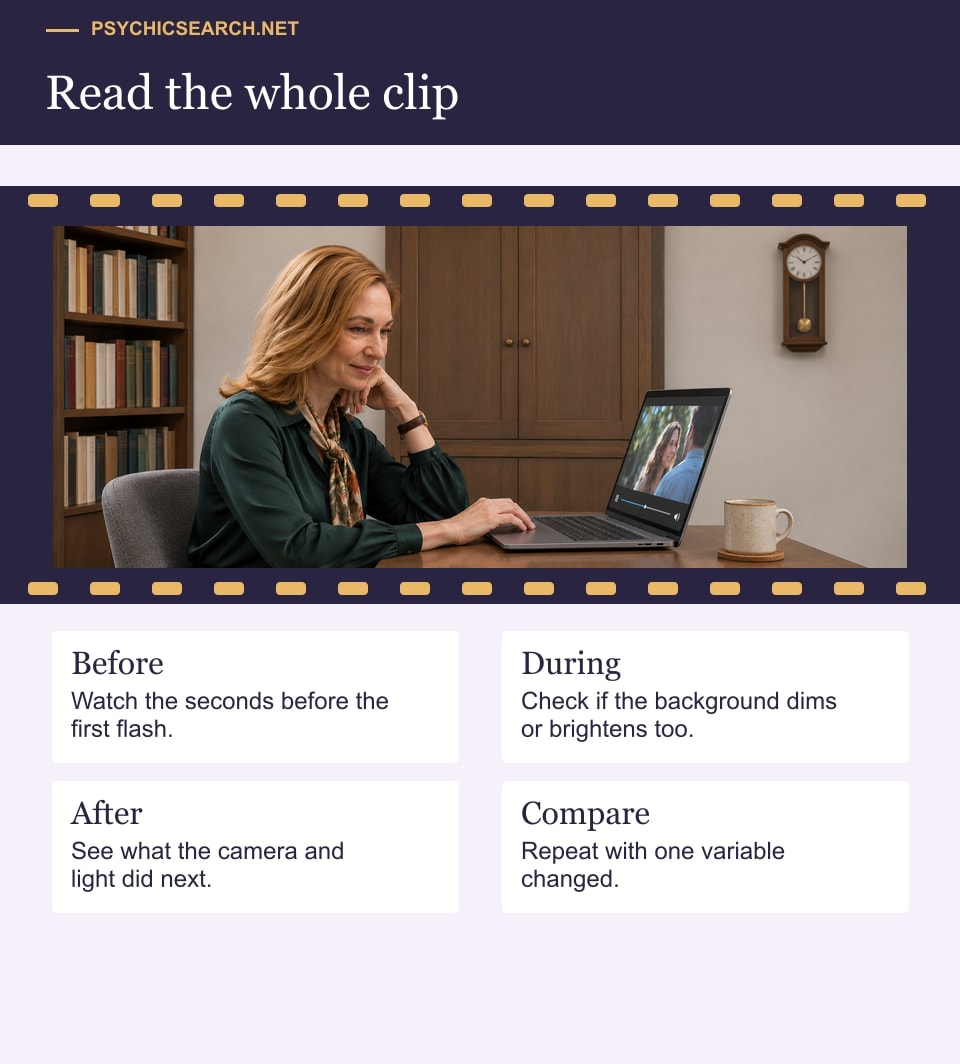
Read the visual guide as text
- Before. Watch the seconds before the first flash.
- During. Check if the background dims or brightens too.
- After. See what the camera and light did next.
- Compare. Repeat with one variable changed.
A flash as the birthday cake arrives
Imagine a phone clip in which a round light brightens just when a cake passes in front of an LED string. Check whether the background darkens as the cake fills more of the scene. Then see if the spot shifts with the camera relative to the candles. The first observation points you toward exposure and the second toward reflections.
If you want a comparison, use a stationary scene with the string lights on, then switch them off and record a second short clip from the same position. This can show how the device handles those lights. It cannot settle what happened every time you see a bright spot.

Write down the timing that mattered to you
Some people read a sudden flash as a call to pause or remember someone. Describe what happened in plain language, then write what it brought to mind. Two timestamps can help: when the video feature appeared and when you noticed or interpreted it.
For flashes you see with your eyes, especially sudden new flashes with many new floaters or a curtain-like shadow, seek urgent eye care. See the National Eye Institute’s guidance on retinal detachment.
Frequently asked questions
1. Why does an orb flash only on camera?
LED flicker, automatic exposure, a moving reflection or an object reflecting infrared light can make a spot pulse in a recording.
2. What part of the clip should I save?
Save the unedited clip, including a few seconds before and after the flash. Keep the recording details if they are available.
3. Does a regular pulse prove something intentional?
A regular rhythm also occurs with artificial lights and camera timing. Check if the same rhythm appears elsewhere in the frame.
4. What is a useful repeat test?
Record the same view with one difference, such as turning off one artificial light. Keep the camera position and other settings the same.
5. When should I get urgent eye care?
Get urgent care for sudden new flashes, many new floaters or a dark curtain or shadow in your vision.