


Tarot can be used as a symbolic conversation or creative reflection exercise. A card draw does not independently predict the future, diagnose anxiety or reveal someone else’s private thoughts. You can use the images to generate questions while keeping decisions grounded in facts.
A useful question leaves room for choice
Try “Which options should I examine?” rather than “What will definitely happen?” You do not need to become perfectly calm or believe in powers to look at a card.
A brief historical correction
Tarot did not begin as a modern psychic service. The Metropolitan Museum of Art’s history of tarot discusses fifteenth-century Italian cards and a trick-taking game. It describes 56 suit cards alongside a fool and 21 trumps. Historical playing cards should not be assumed to share every interpretation in a contemporary guidebook.
Understand your own deck
Many modern tarot decks use 78 cards, described as 22 Major Arcana and 56 Minor Arcana. Names, artwork and numbering can vary. Read the guide for your actual deck rather than assuming one card meaning applies universally.
In many familiar decks the suits are Wands, Cups, Swords and Pentacles. A reader may associate them with action, emotion, thought and practical resources; those associations are interpretations, not energies that control your life.
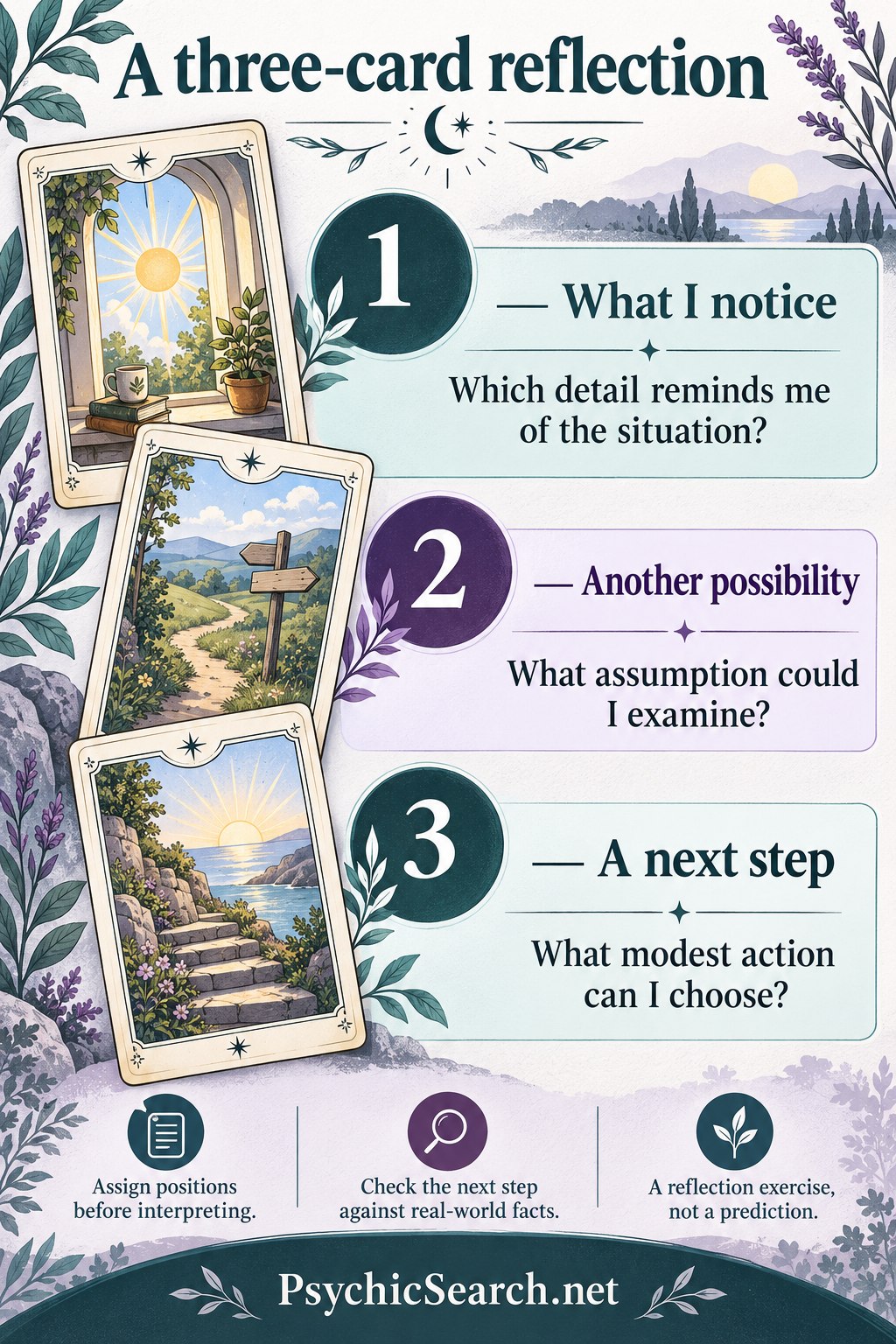
A beginner three-card reflection
- Choose the question. Keep it low-stakes and focused on your choices.
- Shuffle comfortably. Use a method suitable for your hands and cards; no particular hand is required.
- Draw three cards. Assign positions before interpreting them.
- Describe the pictures. Notice details before consulting a meaning.
- Write a practical next step. Check whether it makes sense independently of the draw.
1. What I notice
Which detail reminds me of the situation?
2. Another possibility
What option or assumption could I examine?
3. A next step
What modest action can I choose?
These positions are a suggested exercise, not proof that the cards know the situation.
Keep clear boundaries
Do not use cards to choose treatment, make investments or accuse someone of deception. Ask permission before reading for another person and allow them to reject an interpretation. Their refusal is not a blockage.
Daily reading is optional. Pause if you keep drawing until you obtain reassurance or feel unable to decide without cards.
Common questions
Does an unsettling card predict disaster?
No. A picture is not a verified warning. Examine the actual concern rather than buying protection.
Must I use reversed meanings?
No. Choose a consistent approach for the exercise without claiming one method is universally correct.
Can I reflect without a deck?
Yes. The three questions work in a journal or conversation.
While the practical aspects of tarot card reading are exhaustively covered, it would have been beneficial to include perspectives from psychology or other scientific viewpoints.
The article explains tarot card suits and their meanings very clearly. However, it’s essential to approach such practices with an open but critical mind.
The distinction between Major and Minor Arcana cards is well-explained. This seems to be a foundational aspect for anyone looking to understand tarot readings better.
The historical background provided in the article is quite insightful. It’s intriguing to see the evolution of tarot cards from a parlor game to a tool for divination.
The steps for performing a tarot reading are outlined in a manner that is easy to follow. This could be quite helpful for beginners.