

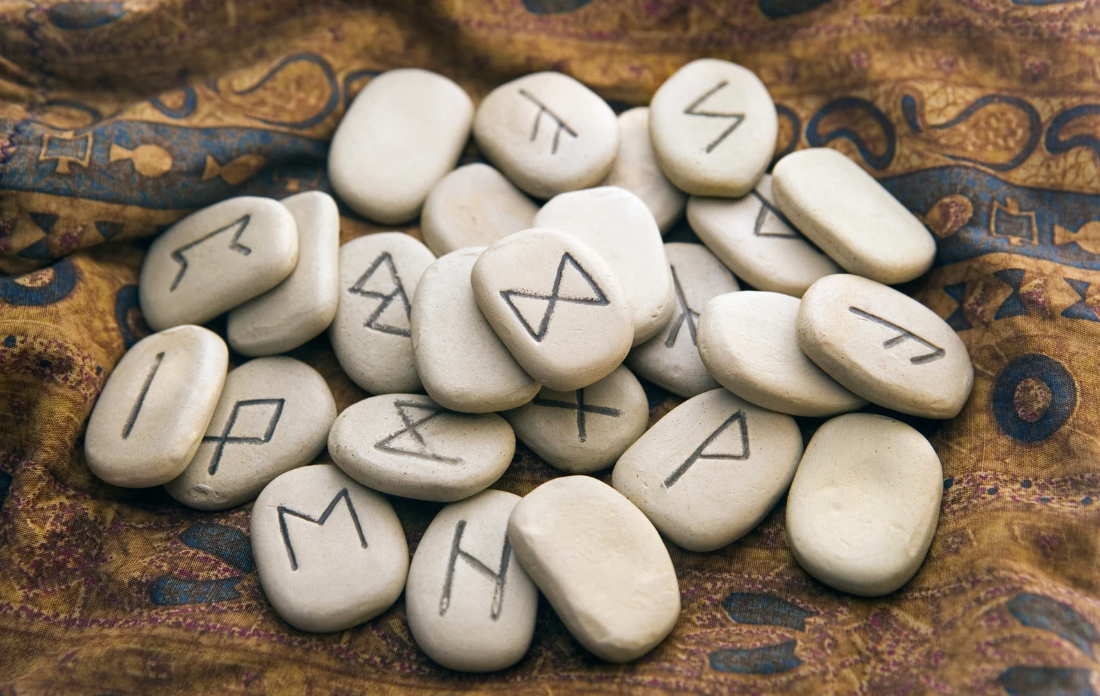
Runes are characters used in historical writing systems. Some modern practitioners also use marked tokens for divination or reflection. These are different uses: an inscription is historical evidence, while a symbolic reading does not independently establish a prediction.
Begin with writing, not fortune-telling
The National Museum of Denmark’s rune guide describes runes as a Germanic writing method developed in the centuries after the beginning of the common era. It links to a database of Danish inscriptions with English translations.
Five runes on a comb from Vimose
One place to see runes doing the work of letters is a comb found at Vimose on the Danish island of Funen. The comb dates to the second century CE. Someone cut five characters into it. Scholars can read them as harja. The harder question is what the word meant to the person who put it there. In a study published by Museum Odense, the author weighs competing explanations and favors a personal name. The letters alone cannot tell us who held the comb or why someone marked it.
Use a source for the actual alphabet
Runic systems differ by period and place. Do not assume every token set is the same as an ancient inscription or that a modern guide’s keyword is a complete historical translation. When learning, identify the alphabet and source you are using.
Modern readings are interpretations
A reader may draw or cast tokens and connect a character with a theme such as a gift, a journey or a need. The selected theme is not evidence that a particular event will happen. A symbol associated with protection cannot guarantee safety.
A blank token in a modern set is not a written character. If a guide includes one, treat its meaning as part of that guide’s system rather than proof of an ancient rule.
A simple optional exercise
- Choose a low-stakes question about a goal or creative project.
- Use your set’s guide to describe the selected symbol.
- Write one question it suggests—not an instruction you must obey.
- Compare the idea with the facts and constraints of your situation.
- Keep, change or reject it.
For instance, if a guide gives your token the theme of a journey, you might ask, “What would I need to learn before taking my first pottery class?” Looking up the class schedule can answer part of that question. Drawing the token cannot tell you whether the class will suit you.
No smoke cleansing, crystal material, particular hand or expensive purchase is required. Written cards can serve as prompts without carving or tools.
Make or handle objects safely
If you enjoy crafts, choose materials and methods appropriate to your skill. Keep small pieces away from children and pets. Do not gather objects from protected places or use unfamiliar minerals in water or remedies.
Limits that matter
Do not use runes to diagnose illness, choose medication, establish guilt, predict a death or decide an investment. They cannot confirm another person’s feelings or override consent. Ask before offering a reading.
Common questions
1. Do matching readings verify an answer?
No. Agreement between interpretations is not independent evidence.
2. Must I use a blank token?
No. Follow a clearly identified system if you choose, without claiming it is obligatory or historically universal.
3. Where can I learn about inscriptions?
A museum catalogue is a good place to start. Look for the object, its date and a transcription of the letters. The National Museum of Denmark also points readers to a searchable collection of Danish inscriptions.
The list of runes and their meanings is informative. Knowing what each rune symbolizes can certainly help individuals seeking answers or guidance through this form of divination. The meanings assigned to each character seem to cover a broad spectrum of life aspects.
The historical context provided in the article about runes being used during Germanic and Anglo-Saxon times is quite fascinating. The detailed explanation of the Elder Futhark alphabet and its 24 characters adds depth to understanding rune divination.
The concept of a blank rune, or Odin’s rune, adds an interesting layer to rune casting. The debate around its use, whether it should be included or not, highlights the subjective nature of divination practices. It’s intriguing how different interpretations can coexist.
Indeed, the variability in interpretations signifies the personal touch often involved in spiritual and divination practices. It’s a reminder that such tools are often tailored to the user’s beliefs and experiences.
The blank rune adds a bit of mystery to the practice, which can be both appealing and complex. It represents the unknown and the concept of fate, making the divination process more nuanced.
The mention of the blank rune first appearing in the 1983 ‘Book of Runes’ adds an interesting modern twist to this ancient practice. It’s a reminder that traditions evolve and new interpretations can arise over time.
It’s interesting to see how runes are used in modern times for psychic readings and spiritual guidance. The process of making your own runes, as described, seems quite elaborate and would likely be a meaningful experience for those who practice it.