


A chakra map can be used as a set of themes for thinking about a situation. It does not measure your consciousness, diagnose your body or prove that one person’s perspective is spiritually higher than another’s.
A map is not a command
The familiar seven-center model offers language for stability, creativity, agency, connection, expression, perspective and meaning. Descriptions vary. You can borrow a useful question without accepting claims about invisible energy or completing every category.
Try the map with a shared decision
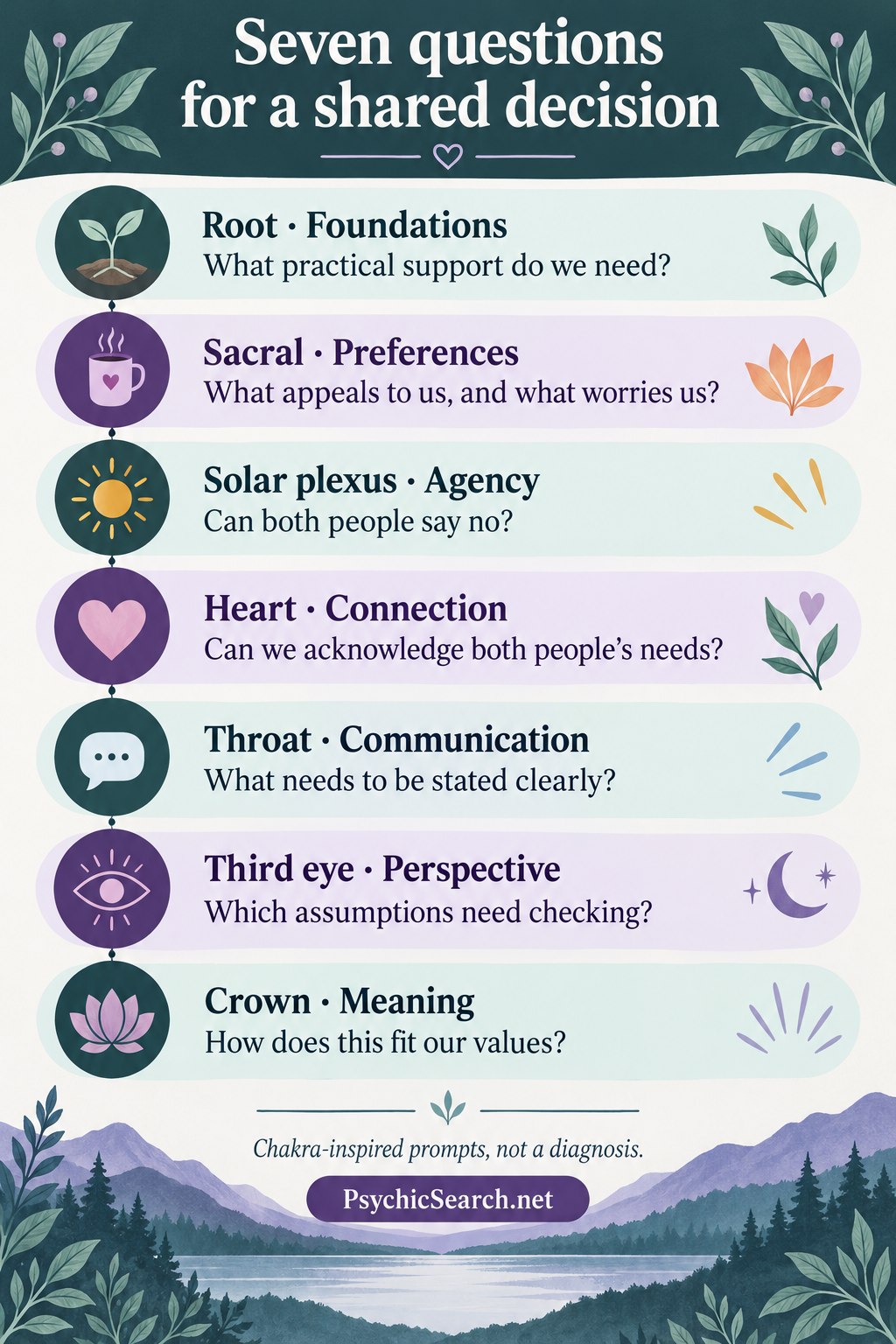
Imagine that you and a partner are considering a move. Rather than asking which chakra must be fixed, consider the ordinary issues:
- Root—practical foundations: Can we afford it, and what support would we need?
- Sacral—feelings and preferences: What appeals to each of us, and what worries us?
- Solar plexus—agency: Are both people able to say no without pressure?
- Heart—connection: Can we acknowledge each other’s needs without dismissing our own?
- Throat—communication: What information or agreement needs to be stated clearly?
- Third eye—perspective: Which assumptions need checking?
- Crown—meaning: How does this choice fit our values?
These are proposed discussion prompts, not claims that chakras control housing, money or relationships. The useful result is a clearer conversation and a practical next step.
Choose one question at a time
You might discover that a concrete issue matters most: rent, travel distance or unequal responsibilities. Work on that issue instead of searching for a higher level of awareness. You do not need to regard everyday needs as less evolved.
Write what you know, what remains uncertain and who can help clarify it. A spiritual framework cannot replace advice from a qualified professional when the question needs medical, legal or financial expertise.
Keep optional additions optional
Some modern systems add centers such as “earth star” or “soul star.” They should not be presented as a universal standard or a ladder everyone must climb. If a map becomes confusing or restrictive, use straightforward questions instead.
When the map is not useful
Set it aside if it encourages blame, fear or repeated spending on balancing services. Physical symptoms and persistent distress need appropriate assessment, not a conclusion drawn from a symbolic checklist.
For another practical approach, see chakra symbolism and its limits. You can use a metaphor lightly and still make decisions from evidence, consent and your actual circumstances.
The breakdown of how each chakra relates to aspects of a relationship is quite detailed. It provides a clear and structured way to understand the different dimensions of our interactions with others.
This article offers an interesting perspective on how chakras can provide a framework for understanding different life experiences. It’s a well-rounded approach for those who are already familiar with basic chakra concepts.
The use of chakras to navigate life experiences is a unique take. It seems to suggest that one’s level of consciousness can be managed by focusing on different chakras. This could be a helpful tool for those looking for a structured way to approach personal growth.
The concept of ‘Condo and Levels of Consciousness’ presents a metaphor that might resonate with many. It simplifies the complex idea of chakras into a more relatable context.
This article is insightful for those already acquainted with chakra basics. The idea that working on different chakra levels can affect our consciousness and interactions is compelling and worth exploring further.