


A daily spiritual routine can offer a moment to reflect on what matters to you. It does not need to transform your whole life, follow a strict schedule or produce a particular feeling.
You influence some parts of your life, but you do not create every circumstance. Health, money, other people’s choices and access to support can all affect what is possible.
Start with a routine you can actually use
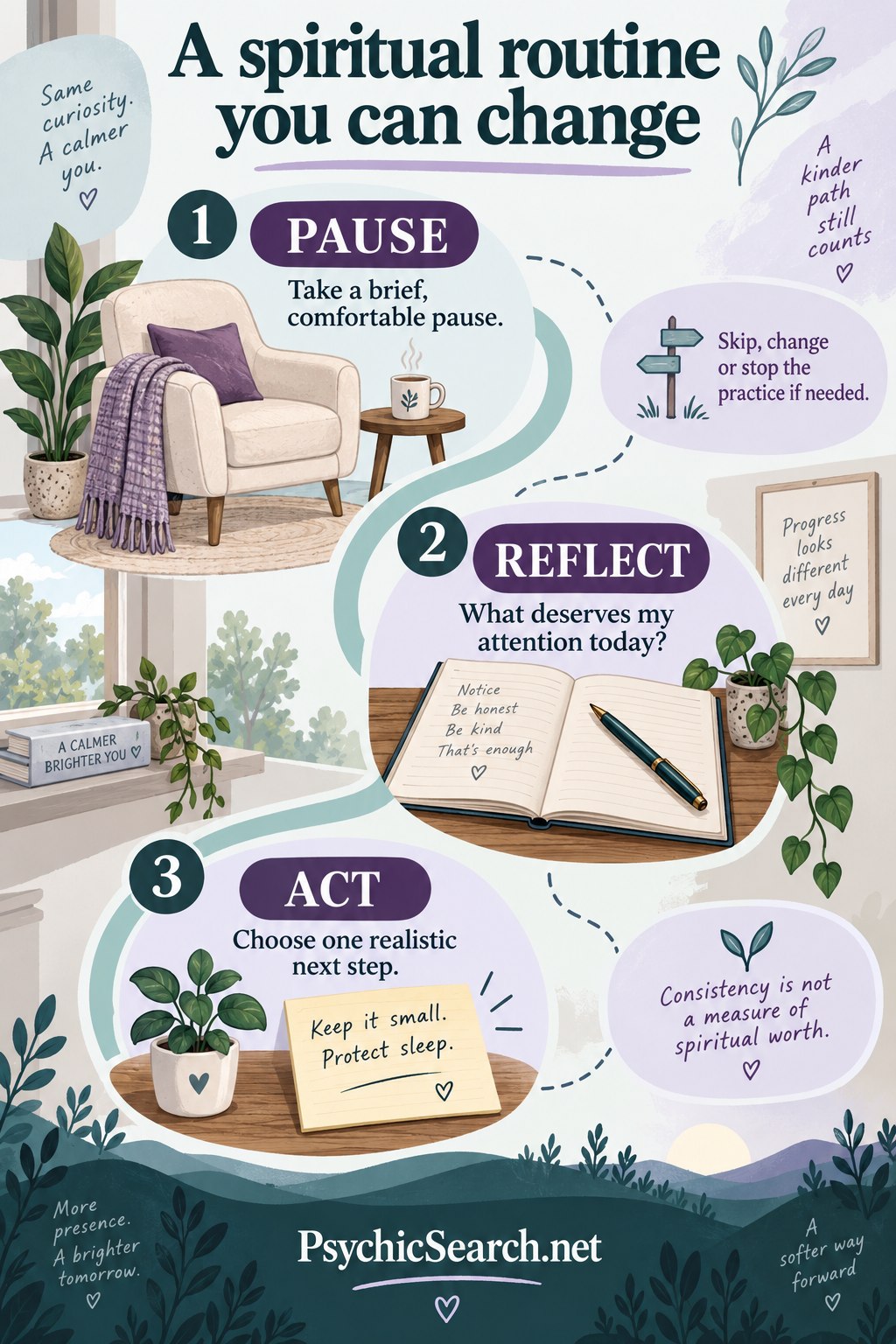
Pause
Take a brief comfortable pause. You can sit, stand or move gently; special posture, closed eyes and early waking are not requirements.
Reflect
Choose a short prayer, a meaningful passage or a question such as “What deserves my attention today?”
Act
Pick one realistic next step: send a message, prepare a meal, seek information or protect time for rest.
Make it flexible
Two minutes may suit you better than an hour. Try a time that fits your day without sacrificing sleep. You can skip a day, change the practice or stop entirely; consistency is not a measure of spiritual worth.
If silence feels uncomfortable, consider an ordinary walk, music or a brief written reflection instead. Avoid forcing yourself to stay with an exercise that feels overwhelming.
Use gratitude without denying difficulty
You may notice something supportive—a kind conversation, a useful tool or a moment of ease. You do not have to feel grateful for pain, compare your circumstances with someone else’s or pretend that everything is fine.
A reflection can hold two truths: “This is difficult” and “I want to find one source of support.” Disability, illness or needing help does not diminish your worth.
Keep affirmations realistic
Instead of “I can achieve anything if I believe,” try “I can explore the next step and ask for help.” Instead of “Only I determine my happiness,” try “I can care for what is within my control while acknowledging what is not.” Use words that feel honest rather than another demand to be positive.
Reflection and action belong together
Prayer or visualization cannot guarantee money, health or another person’s response. For a practical problem, pair reflection with appropriate information, planning and support. A spiritual practice is not a substitute for professional care.
A short end-of-day check
- What did I notice today?
- What helped, and what felt like pressure?
- What can wait until tomorrow?
- Is there someone I want to ask for help?
There is no need to find a lesson in every event. If you want a more structured practice, read our guide to meditation, possible benefits and limits. Choose practices because they fit your needs—not because someone says you must raise your vibration to deserve a better life.
The idea that transformation should be left to the ‘divine and the spirit of the universe’ is intriguing. It bridges the gap between personal effort and spiritual faith.
Yes, it offers a balanced approach between taking personal responsibility and having faith in a higher power, which could be comforting to many.
The article presents an interesting perspective on the role of individual agency in creating personal change through spiritual practices. It emphasizes the importance of mindset and daily routines which many would find valuable.
The emphasis on gratitude and affirmations is noteworthy. It aligns with many psychological studies that suggest these practices can improve mental well-being and life satisfaction.
While the article advocates for self-driven change and a spiritual routine, I wonder how these practices integrate with practical aspects of life such as work and family obligations.
The concept of a unique spiritual routine tailored to individual needs is quite appealing. However, how does one stay motivated to maintain such a routine?
Maintaining motivation could be challenging, but perhaps the key lies in the rewards of increased joy and fulfillment that the article mentions.